Computing Project
Team-based quantitative project in C++ with Excel/VBA interfacing.
 Mathematics of Finance at Paris-Saclay

Mathematics and Applications Graduate Program
Master 2 Quantitative Finance

Mathematics of Finance at Paris-Saclay
The Master 2 Quantitative Finance trains specialists able to model, simulate, calibrate, and analyze complex financial problems using mathematics, statistics, programming, and machine learning.
About the Program
The first semester is devoted to the foundations of the quantitative finance toolkit: stochastic calculus, numerical methods, programming, financial econometrics, actuarial finance, risk management, and statistical learning. The second semester moves toward advanced derivatives, regulation, high-frequency data, stochastic control, applied deep learning, and a professional internship.
The program explicitly seeks a balance between rigorous theoretical coursework and applied training, with several modules taught or co-supervised by professionals. This connection between academic depth and real-world practice is central to the identity of the degree.

Admissions
The program is designed for applicants with a strong Master 1-level or equivalent background in probability, statistics, financial markets, and programming, especially in C and Python.
Inception platform
From January 30, 2026 to June 30, 2026.
Fees and scholarship arrangements may vary depending on the student’s administrative situation. Current official information should always be checked directly on the Paris-Saclay program page.
Our Curriculum
The structure below reorganizes the full official program content into a clearer editorial format: overall progression, key courses by semester, and detailed course descriptions.
Core quantitative methods, numerical tools, statistics, and computing.
Team-based quantitative project in C++ with Excel/VBA interfacing.
Monte Carlo, hedging, Greeks, discretization, and calibration.
MLP, regularization, RNN, CNN, and applied deep learning methods.
C++, object-oriented programming, dynamic memory, templates, and VBA.
Vasicek, Hull-White, CIR, HJM, LMM, and calibration.
Swaps, forwards, futures, options, and structured products.
Trees, random forests, boosting, clustering, and dimension reduction.
Brownian motion, Ito calculus, SDEs, Girsanov, and finance PDEs.
Time series, GARCH, volatility estimation, and high-frequency data.
ALM, variable annuities, insurance products, and insurer risk.
Market risk, credit risk, liquidity, stress testing, and scoring.
Advanced applied topics, regulation, project work, and internship.
Extended immersion in industry or research.
Grammar, listening, reading, and intensive exam preparation.
Rates, FX, rough volatility, and structured products.
McKean dynamics, propagation of chaos, and finance/ML applications.
Optimal control, HJB, BSDEs, ruin theory, and liquidity.
Industry-facing team project in quantitative finance.
Risk premia, ESG, portfolio optimization, and allocation.
Pricing, calibration, and hedging using ML and deep learning.
Microstructure, Hawkes processes, market impact, and simulation.
CVA, DVA, FVA, MVA, KVA, and balance-sheet optimization.
SDE discretization, Greeks, exotics, and Monte Carlo error.

Course Details
ECTS: 3. Semester: 1. Language: English.
Contact hours: 2h lecture, 10h tutorial.
Content: C++ project with Excel/VBA interface on quantitative finance topics.
Goal: Conduct a full quantitative programming project in pairs.
ECTS: 6. Semester: 1.
Content: Review of stochastic analysis, Monte Carlo, variance reduction, advanced Greeks, exotic pricing, SDE discretization, and calibration.
ECTS: 3. Semester: 1.
Content: Perceptrons, multilayer networks, backpropagation, activation functions, regularization, recurrent and convolutional networks.
ECTS: 6. Semester: 1.
Content: Object-oriented C++, encapsulation, constructors, operator overloading, inheritance, dynamic allocation, templates, and introductory VBA.
ECTS: 3. Semester: 1.
Content: Rate derivatives, short-rate models, Hull-White, CIR, HJM, Libor Market Model, and market calibration.
ECTS: 3. Semester: 1.
Content: Rate hedging, swaps, forwards, futures, vanilla options, CRR and Black-Scholes models, structured products, and investment strategies.
ECTS: 6. Semester: 1.
Content: Parametric and non-parametric models, trees, bagging, random forests, boosting, PCA, Gaussian mixtures, spectral clustering, and ROC analysis.
ECTS: 6. Semester: 1.
Content: Brownian motion, Ito formula, stochastic differential equations, Feynman-Kac representation, Girsanov theorem, pricing and dynamic hedging.
ECTS: 3. Semester: 1.
Content: Time series review, stylized facts, GARCH, volatility forecasting, VaR, duration models, and high-frequency estimation.
ECTS: 3. Semester: 1.
Content: Traditional insurance products, fixed annuities, CPPI, variable annuities, ALM, and insurer risk mitigation.
ECTS: 6. Semester: 1.
Content: Market, credit, counterparty, operational, liquidity, and model risk, as well as copulas, EVT, scenario analysis, and credit scoring.
ECTS: 4. Semester: 2.
Content: Yield-curve modeling, fixed-income management, structured rates products, FX derivatives, rough volatility, and structured products.
ECTS: 4. Semester: 2.
Content: Particle systems, propagation of chaos, McKean diffusions, mean field games, and applications to machine learning and finance.
ECTS: 4. Semester: 2.
Content: Optimal stopping, switching, singular control, duality, dynamic programming, HJB equations, viscosity solutions, quadratic BSDEs, capital structure, dividends, and ruin theory.
ECTS: 4. Semester: 2.
Content: Group project on a topic defined by industry professionals, with academic co-supervision.
ECTS: 2. Semester: 2.
Content: Risk-based investing, smart beta, ESG, large-scale optimization, robo-advisors, machine learning, and calibration.
ECTS: 2. Semester: 2.
Content: Applications of machine learning to pricing, calibration, and hedging, with a focus on deep neural networks and Gaussian processes.
ECTS: 2. Semester: 2.
Content: High-frequency data, trade and quote streams, Poisson and Hawkes processes, limit order books, and empirical market impact.
ECTS: 2. Semester: 2.
Content: CVA, DVA, FVA, MVA, KVA, conditional expectations, expected shortfall, nested Monte Carlo, and deep-learning methods.
ECTS: 2. Semester: 2.
Content: Brownian SDE discretization, strong and weak errors, barrier/lookback/asian options, Greeks, and Monte Carlo concentration bounds.
Internship: 15 ECTS in Semester 2, with immersion in industry or research.
TOEIC: 2 ECTS, including grammar, listening, reading, and intensive preparation.
Career Development
The degree prepares students for roles such as quantitative analyst, R&D engineer, financial analyst, statistician, and data scientist. It also supports careers in market risk, credit risk, insurance, asset management, and advanced analytics.
The academic depth of the program also supports doctoral continuation and research-oriented paths in applied mathematics, stochastic modeling, quantitative finance, and statistics.
Alumni
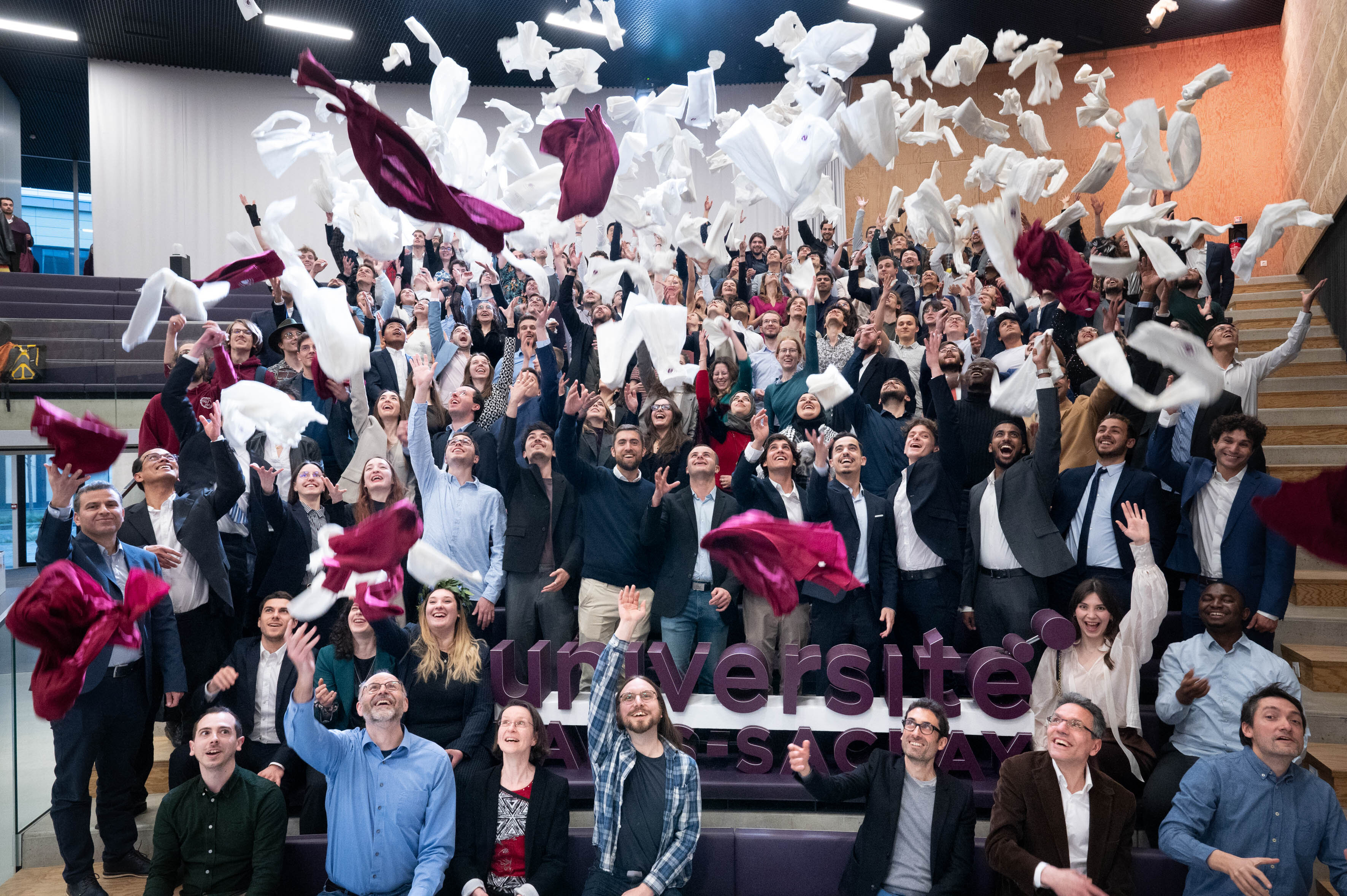
The program aims to build a strong alumni network across quantitative finance, risk, data science, insurance, and research. Graduates can remain involved through mentoring, internship referrals, recruiting conversations, and guest talks.
This section can host alumni stories, employer introductions, and short profiles of graduates working in banks, insurance, consulting, fintech, and doctoral research.

Meet the Team and Learn More
Prof. Ahmed Kebaier & Prof. Vathana Ly Vath
Teaching location: Evry
Head office: 3 rue Joliot Curie, Batiment Breguet, 91190 Gif-sur-Yvette
Public reception: 9 rue Joliot Curie, Batiment Bouygues, 91190 Gif-sur-Yvette
Phone: +33 1 69 15 67 50